
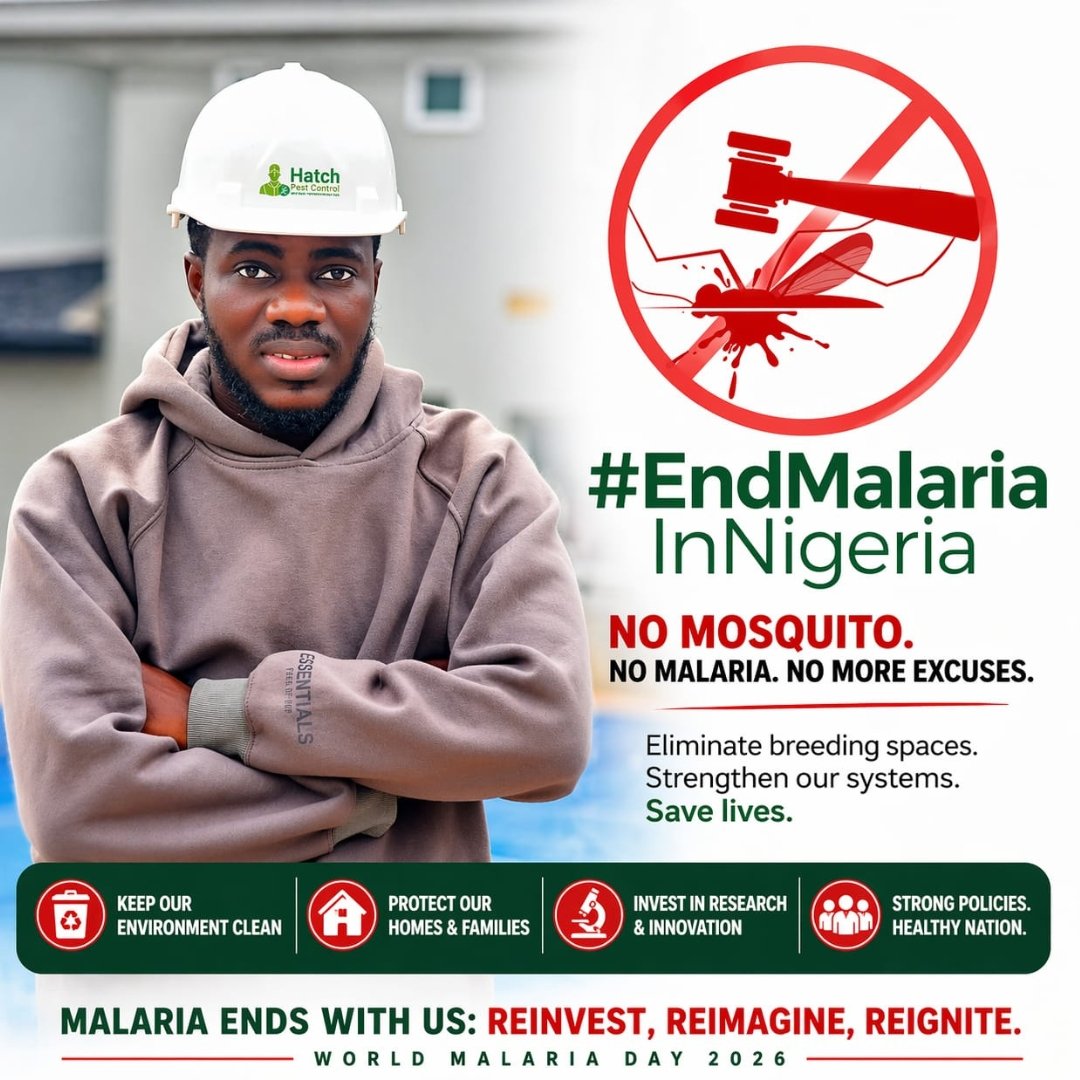
65 Years of Failure: Nigeria Still Breeds Malaria While Its People Pay the Price”
Today, as the world commemorates World Malaria Day 2026 under the theme “Malaria Ends With Us: Reinvest, Reimagine, Reignite”, we are once again confronted with a painful and unacceptable reality: Nigeria remains the global epicentre of malaria, accounting for nearly a quarter of all cases worldwide and an alarming proportion of global deaths.
As a preventive approach campaigner and environmental health professional, we state unequivocally that this is not merely a public health failure; it is a failure of leadership, planning, and political will.
For over 65 years since independence, Nigeria has had no clear, actionable, and measurable roadmap toward malaria elimination. What we have instead is a cycle of reactive responses, donor dependency, and a dangerous neglect of preventive systems that could drastically reduce transmission.
GOVERNMENT NEGLIGENCE AND SYSTEMIC FAILURES
The Nigerian government’s approach to malaria control has remained lacklustre, fragmented, and insensitive to the lived realities of citizens. Key indicators of this failure include:
- The collapse and underfunding of vaccine and medical research centres, leaving the country dependent on external interventions.
- The normalisation of medical tourism by political elites, who abandon the very health system they are meant to build.
- The persistent failure of urban planning and drainage systems, creating ideal breeding grounds for mosquitoes across cities and rural communities.
- The absence of sustained, science-driven environmental sanitation systems.
This systemic neglect has turned malaria into a disease of poverty and governance failure, disproportionately affecting children, pregnant women, and low-income households.
THE ECONOMIC AND SOCIAL BURDEN
Malaria continues to place an overwhelming financial burden on Nigerians, with millions of households spending scarce resources on treatment, hospital visits, and medications annually.
Beyond direct costs, malaria leads to:
- Loss of productivity
- Increased school absenteeism
- Strain on already overstretched healthcare systems
- This is a crisis that keeps millions trapped in poverty.
PREVENTION MUST BE THE PRIORITY
Malaria is preventable. Yet Nigeria continues to prioritise treatment over prevention.
The primary driver of malaria transmission is the unchecked proliferation of mosquito breeding sites, stagnant water, blocked drainage systems, refuse dumps, and poorly managed environments.
However, it must be clearly stated that environmental sanitation is not the obsolete model of monthly lockdown-style sanitation exercises, where citizens are confined indoors for hours with little measurable impact.
What Nigeria needs instead is a modern, scientific, and continuous environmental management system, which includes:
- Waste sorting at source (household level)
- Adoption of modern waste collection and evacuation systems
- Development of engineered sanitary landfills, replacing open dumping
- Continuous sanitation practices, not monthly rituals
- Data-driven vector surveillance and environmental monitoring
HOUSING, POWER, AND REALITY OF PREVENTION
Furthermore, malaria prevention strategies must reflect the real living conditions of Nigerians.
It has become increasingly difficult for families to effectively use insecticide-treated mosquito nets in a society where:
- The power supply has largely collapsed, making cooling systems like fans or air conditioning inaccessible
- Many Nigerians live in poorly planned, overcrowded, and poorly ventilated housing
- High temperatures and humidity make sleeping under nets physically uncomfortable and suffocating
In such conditions, expecting consistent use of mosquito nets without addressing housing quality and electricity supply is unrealistic. Public health interventions must be practical, humane, and adapted to environmental realities.
RESTORE ENVIRONMENTAL HEALTH INSTITUTIONS
There must also be an urgent restoration and strengthening of environmental health departments at the local government level.
These departments must:
- Return to their core public health responsibilities of inspection, sanitation enforcement, and vector control
- Be adequately funded, staffed, and equipped
- Operate as public health institutions, not as tools for revenue generation
- Environmental health officers should be at the frontline of malaria prevention, not sidelined or commercialised.
THE NEED FOR A SCIENTIFIC AND INTEGRATED APPROACH
No single intervention can eliminate malaria. Nigeria must adopt a multi-sectoral, science-driven strategy that combines:
- Environmental management and vector control
- Widespread use of insecticide-treated nets (with improved living conditions)
- Access to effective diagnostics and treatment
- Vaccination programs where applicable
- Strengthened local research and innovation
- Critically, prevention must lead the strategy, not follow it.
IMMEDIATE ACTIONS REQUIRED
We call on the Nigerian government to urgently do the following:
- Develop and publish a national malaria elimination roadmap with clear timelines and accountability mechanisms.
- Invest heavily in modern environmental health infrastructure, including drainage, waste systems, and sanitary landfills.
- Revive and fund local medical and vaccine research institutions.
- Replace outdated sanitation policies with continuous, science-based systems.
- Strengthen and depoliticise environmental health departments at local government levels.
- Improve housing standards and expand reliable electricity access to support preventive measures.
- Ensure functional primary healthcare systems for early diagnosis and treatment.
- End the culture of medical tourism among public officials, and reinvest in Nigeria’s health system.
CONCLUSION
Malaria should not still be killing Nigerians in 2026.
Ending malaria is not beyond our reach; it requires political will, scientific thinking, and a decisive shift toward prevention.
We must move from rhetoric to action. From outdated practices to modern systems. From neglect to responsibility.
The time to act is now.
Francis Nwapa
Convener: #EndMalariaInNigeria
0 Comments